Thursday, October 19, 2006

Changing the Face of Searching?

Well, as you may have heard by now, Ms. Dewey is a brand new search engine that is taking a run at Google. Reviews are all over the blogosphere now. However, it's so unique that I'm going to hop onto the Blogosphere Express and offer my two cents:

(1) Interface - Well, what more can I say. It's definitely a diversion from Google's simplicity. There's more to look at, that's for sure. But I like it. It's fresh, dynamic, and interactive. The only drawback is that the search results are a bit cumbersome to navigate.

(2) Web 2.0-compatible - To date, there's still no search engine that makes witty comments, shows signs of moodiness, and has an interest in your searches. True, it's artificial, but it's still not a bad attempt at user interaction. When one types in a search term or phrase, Janina offers a commentary. If the question is bizarre enough, Janina might even perform a short skit.

(3) Effectiveness - In the end, the question is, can it do what it's supposed to do? I've done quite a few searches. It's definitely no Google. A little trick that I use to determine an engine's effectiveness is to try finding a journal article by simply by typing in the full (or partial) article title. Ms. Dewey unfortunately comes up short (but so does Yahoo! and MSN Live). Google still rules at the end of the day.

(4) A new type of search engine - The "traditional" search engine days of Google and Yahoo! are increasingly challenged by up and comers. The clustering search engines such as Clusty and Vivisimo are great tools; and the visual search engines like Kartoo are also great as well. And now we have the "interactive" search engine. What does this all mean? There's still a ways to go before Ms. Dewey can offer us searchers something substantial. Perhaps Janina can offer a witty remark to that.

Tuesday, October 17, 2006

Restful in Seattle

Sunny weather. Good food. Great people. Even greater conversations. Exactly what I experienced from a very successful and rewarding conference down in Seattle from the PNC/MLA Conference, "Mission in the Mountains." Still processing the vast amount of information absorbed from the speakers, presentations, and posters, I'm excited to present my take of the trip.

But what was my highlight of the conference? Definitely the Roundtable Luncheon where a group of highly motivated and curious librarians and information professionals talked about wikis, blogs, and RSS. I was asked what was Web 2.0. I've been blogging a great deal about social software and learning as much as I can about this fascinating topic, but when asked what it all means, I ironically stumbled for the right explanation, and was almost at a loss for words about Web 2.0 and its implications for an library and information centre setting? So much to say, where to begin?

I managed to summarize my ideas in less than three sentences, crunched with key terms as "user-centred," "open access," and "social interaction." More importantly, I stressed that Web 2.0 is not easily definable -- rather, it is "state of mind." Had I known that I would be asked for my opinion, I would have introduced to my colleagues a wonderful article by Jack Maness, "Library 2.0 Theory: Web 2.0 and Its Implications for Libraries," which is fittingly published from an open-access journal. Web 2.0 is still in a fairly new, and experimental stage, and requires time for evolution. The best is yet to come. I hope that my message had got across the table. Maybe. Just maybe.

Saturday, October 14, 2006

Library 2.0 -- An Experiment

I feel like we're all taking the same train. But more the merrier: all aboard. Library 2.0: An Academic's Perspectives has written a wonderful blog about an actual real-life example about a library that uses social software. This is what he writes:


There are some people who rightly sing the praises of the Ann Arbor District Library because its site is blog-based. However, blogs are restrictive relative to wikis in that the typical user cannot create an entry but only comment on it. In the library context, librarians are in control of their Web site content and users can only respond. This is valuable, to be sure, but in terms of radical trust (a Library 2.0 buzzword), it falls short.

This is a fascinating experiment. A blog is a good start - but wikis? Why not? I say, go for it. The possibilities are endless (IF designed properly). There are probably other library catalogues that are using social software features. Where are we going? Hopefully, to a more interactive, more accessible tool for users and patrons for all libraries and information systems. The game's still early, but it's already very promising from the looks of Ann Arbor District's brave, bold step forward.


To Blog, or Not to Blog, that is the Question

I'm a proponent of looking at both sides of a coin. While I'm a huge supporter of social software and its potential impacts on the information society, I am also interested in listening to the arguments against blogging and its potential controversies.

A few months ago, GeekNurse was shut down due to management concerns. The symptoms? "Management-concern-itis." According to blogosphere rumours, hospital managers could not stand an employee's public persona and growing following. Of course, blogging is a powerful social tool where online communities can share ideas and exchange commentaries, but can an organization be really threatened by one person's "cult" following? Can blogging really be so detrimental to a work place environment, particularly one that deals with health?

Let's hope that the controversial shut down of Geek Nurse does not set a trend. When personal homepages became possible in the early 1990's, the same jittery fears brewed in cyberspace. Employees were fired, scandals broke, and homepages hacked. But eventually, things died down, and in fact, so did personal homepages to a certain extent.

What is my take, you ask? Blogging is here to stay. Although it's still too early to tell what blogging will look like a few years from now, we're on the cusp of change and innovation, so my take is to stay tuned and stay alert. Personal homepages from commercial services did not work as well as blogging because as a Web 1.0 technology, homepages did not allow room for social interaction, while blogging does. However, blogging has yet to evolve to the point where it can be considered true Web 2.0. It's still a work in progress, which truly makes this is an exciting time for all.

Saturday, October 07, 2006

Copyright Infringement, You Say?


I recently watched Birth of a Nation on Google Videos, and it was great. I could've rented it or purchased it, but instead of doing all that, I simply typed in the title and voila, 3 hours of history right within my grasp. (Google even entertains as well). While such a phenomen probably deserves a plethora of articles from a communications, information science, sociology, economics, business, and just about any disipline's view point, what is most pressing to me is its place in Web 2.0.

Doesn't it feel like something this good probably crosses some legal ramifications? According to GigaOM's post, yes. In fact, a number of Bollywood hits can be seen online right after its theatre release -- and it's a matter of time that it's going to get out of hand. But in the meantime, isn't it ironically strange that open access is challenging both studios and DVD piracy? I wonder how much Kung Fu Hustle costs out in the black market these days...

Milkshakes and IR's

Monica McCormack's freshly-written Master's thesis is really worth a read. Using business theory, she creatively weaves the proposal that libraries need to market and establish a brand name for insitutional repositories in order for them to succeed. Here is an excerpt:

Seeking to increase milkshake sales, a fast-food company interviewed customers they had identified as key to the "milkshake demographic." Based on that research, they changed their recipes, but sales remained about the same. Further research showed that 40% milkshakes were purchased early in the morning.

They learned that customers facing a long commute wanted a breakfast that would be both filling and easy to eat in the car. Bananas would not hold them until lunch; bagels and breakfast sandwiches were too messy. Milkshakes, despite their relative lack of nutritional value, served these consumers’ needs.

In Christensen’s language, the customers "hired" milkshakes to do a particular job. The company responded by providing milkshake dispensers in front of their counters, where customers could buy them with a simple swipe of a credit card, and created new flavors with chunks of fruit, making the product more fun to eat. Milkshake sales improved. The point of this story is that creators of a new product must ensure that is does what their customers need—and the needs assessment may reveal some surprises.

McCormick makes a strong case. Sometimes, we assume that open access is such an inherently good thing that it's a given that people will eventually come around and realize the future of publishing. Perhaps McCormick reminds us that before we reach that stage, we should explore possible avenues in welcoming others to join us first.

Wednesday, October 04, 2006

Earthbound

What is a mashup, you say? This is a mashup. Innovative. Simple. Functional. User-friendly. To view pictures or videos, just click on a country (Google maps) to reveal a filmstrip view of the images (Flickr) and videos (Youtube) that are available for that country. Since all one needs to do is to tap on the thumbnail so that the video starts playing right on the map, we never even need to leave the map interface. (How nice!)

As this example reveals, there's nothing very revolutionary about mashups. The technology is there. The real ingredients comprise a pinch of creativity and a cabinet of curiosity.

Tuesday, October 03, 2006

The Prowess of GahooYoogle

I was quite surprised when information scientist
Amanda Spinks told us at a talk that search engines usually have a 5% overlap in terms of hits. What this means is that searching is an art more than anything else -- what we come up with really depends on the tools, techniques, experience, and expertise of the searcher. (And dare I say, a certain element of luck, too).

Take a look at GahooYoogle, a nifty search engine which allows us to see results of both search engines, side-by-side. Does this make searching easier? Not really. In my opinion, if you want to do that, then go for a meta-search engine. But if you want to see how the magic of the Google algorithm works compared to another "normal" search engine which uses keyword searching, then try this out.

Do you notice something? One can simply type in the article's full title (or even parts of it, provided it's wrapped around with "quotations"), and wham! there you go, the first few hits will usually lead you to the full or abstract, whereas in a search engine such as Yahoo!, you'll have to work a lot harder to find what you're looking for.

Ah yes, what can't Google do? Another reason why it's still the information professional's best friend.

Monday, October 02, 2006

The Myth of Caduceus?


A majority of medical organizations employ a symbol of a short rod entwined by two snakes and topped by a pair of wings. Known as the "caduceus" or magic wand of the Greek god Hermes, conductor of the dead and protector of merchants and thieves, the caduceus came to be associated with a precursor of medicine, based on the Hermetic astrological principles of using the planets and stars to heal the sick in the 7th century.

However, recent medical observers and physicians have been critical of the symbol, for Hermes also happens to be the god that leads the dead to the underworld and is not only associated with wealth and commerce, but happens to be the patron of thieves (a larcenous figure in Greek mythology). Some medical purists suggest we should go back to the staff of Aesculapius, which is depicted as a single serpent coiled around a cypress branch.

In 2003, Wilcox and Whitham further ignited controversy in the medical community when they published an article in the Annals of Internal Medicine, arguing that the design is derived not from the ancient caduceus of Hermes but from the printer’s mark of a popular 19th-century medical publisher. Because of this mishap, the modern caduceus became a popular medical symbol only after its adoption by the U.S. Army Medical Corps at the beginning of the 20th century. The authors contend that a misunderstanding of ancient mythology and iconography has led to the inappropriate popularization of the modern caduceus as a medical symbol. As they argue, the Asklepian is a medical symbol with a heritage stretching well over two millennia while the modern caduceus became a popular medical symbol only in the early years of the 20th century. Scandalous, you say?

Saturday, September 30, 2006

A Wiki’s Worst Nightmare

Recently, the Health Library wiki team discussed the implications of creating a wiki for the health sciences. Is it useful? Who will use it? Why? How? While we were all excited of the implications of what we were doing, we were really walking on unchartered waters. Either we are stumbling onto something great, or we are wasting our time experimenting with something that's not going to be used other than the few people whom we send out the link to.

One question that we debated about was how to monitor the postings. As Stephen Colbert's now infamous Wikiality monologue reveals, not everyone appreciates the power of wiki. Not everyone will have the faith of a democratic wiki. According to Wikipedia, astroturfing:
consist[s] of a few people discreetly posing as mass numbers of activists advocating a specific cause. Supporters or employees will manipulate the degree of interest through letters to the editor, e-mails, blog posts, crossposts, trackbacks, etc. They are instructed on what to say, how to say it, where to send it, and how to make it appear that their indignation, appreciation, joy, or hate is entirely spontaneous and independent; thus being "real" emotions and concerns rather than the product of an orchestrated campaign.

There have been cases reported of astroturfing. It's a serious matter, particularly for a Health Libray Wiki which relies on both updated and accurate information. It should be taken into consideration, particularly if there are a few unruly who want to leave a legacy by giving false information to hurt the many. Can a few wiki masters constantly monitor such a wide net? That will be a challenge that we will face as we move into the information grassroots democracy. With open access, open collaboration, open authoring, open platforming, and open searching in Web 2.0 comes hurdles which we have to face bravely and heads-on.

Thursday, September 28, 2006

Microsoft and/or Google? Competitors? Or Just Neighbours?


A fascinating but rather dated article caught my attention as I was taking my daily dip into the blogosphere. It brings up an interesting debate that continues to rule the realms of both the corporate and information world: is Google taking over Microsoft's reign? Or are they even competitors in the first place?

According to Why Microsoft can’t best Google, the answer is yes, Google will rule the day (which is tomorrow). Here is why Phil Wainewright thinks so:

(1) Microsoft wants everyone to have a rich desktop experience, Google wants everyone to have a rich Internet experience.
(2) Microsoft's business model depends on everyone upgrading their computing environment every two to three years. Google's depends on everyone exploring what's new in their computing environment every day.
(3) Microsoft looks at the world from a perspective of desktop+Internet. Google looks at the world from a perspective of Internet+any device.
(4) Microsoft wants computers to help individuals do more unaided. Google wants computers to help individuals do more in collaboration. In the Internet age, who wants to work alone any more, when all the unexplored opportunity is in collaborative endeavor?
(5) In a few year's time, who's going to still be working at a desk anyway?

The most interesting food for thought comes from the blog comments. Take a look. Apparently, the reactions are mixed; not everyone thinks that Google and MSN are competitors. One commentator argued that it's comparing "apples to icebergs." In my opinion, Google is certainly moving into MSN's dominance and in many ways (but not all), has surpassed it. However, one piece of technology which has never taken off has been Googletalk, which is supposed to be the rival to MSN Messenger. On the other hand, Gmail is slowly but surely equalling MSN Hotmail in terms of popularity (and definitely ease of use). Time will tell who will win, or whether winning is the end goal...

Monday, September 25, 2006

A Good Blog

To be good at something, one should always look to the best. And recently, one medical librarian's blog that has caught my attention is the Krafty Librarian. Just when I thought I had stumbled onto sliced bread, it turns out that someone has already gone on to desserts. Such is life... The Krafty Librarian focuses mainly on cutting edge issues about technology - and recently she has turned her focus of attention towards mashups. She has scoured the internet looking for mashup applications, particularly those with a health sciences library-related focus.

I'm anxiously anticipating her upcoming blog entry, as she has promised to write about mashups and their potential applications impact in the health sciences. The Krafty Librarian's most recent entry introduces us to Library Elf - a personal library reminder service that lets create their own username and password then they select their library and then they give Library Elf their library card number and pin number. If the patron's library is not listed they can recommend it to Library Elf to have it listed. Thus, the users then can receive emails, text messages, and RSS feeds for renewal reminders, overdues, and hold items at one click of the mouse (or a few). What do you think? Is it viable?

It's this sort of "mashing" up of different programs and applications through API that makes the future of online technology that much more intriguing.

Thursday, September 21, 2006

The "New" Web


Prior to coming across Tim O’Reilly’s “What is Web 2.0," I was still lost in the maze that is now referred to the new web 2.0. Blogging, Wiki's, podcasts, etc. etc. were merely a rehash of previous technologies. (I realize I've been harping on this point for ages - so I apologize for the repeat). However, O'Reilly allays my suspicion with the opinion that Web 2.0 is not meant to be a radical transformation - it is not meant to systematically alter the internet as we know it. Rather, Web 2.0 is a progressive and more interactive approach to online information.

The concept of "Web 2.0" began with a conference brainstorming session between Tim O'Reilly and MediaLive International. O'Reilly, who actually majored in Classics but moved onto the computer manuals business, realized that companies that had survived the collapse all had some things in common. To O'Reilly, the dot-com collapse marked a turning point for the web.

But there's still a huge amount of disagreement about just what Web 2.0 means, with some people asserting that it as a marketer's buzzword, while others take it as the holy grail. (I was somewhere in the middle). O'Reilly's article is definitely worth a read for those uninformed about social software or skeptical about its applications. Here are some of his main points:


Web 1.0 ------verus ------- Web 2.0
DoubleClick ----------------> Google AdSense
Ofoto ----------------------> Flickr
Akamai ---------------------> BitTorrent
mp3.com
-------------------> Napster
Britannica Online ------------> Wikipedia
personal websites ------------> blogging
evite ------------------------> upcoming.org
domain name speculation----> search engine optimization
page views ------------------> cost per click
publishing -------------------> participation
content management ---------> wikis
directories (taxonomy) -------> tagging ("folksonomy")
stickiness -------------------> syndication


Does this look eerily similar to the modern/postermodern dichotomy so hotly contested within academic circles? Sure does to me. But this is a good thing, and a worthwhile discourse in LIS. I see the future of library and information science, and it is headed in the direction of Web 2.0. I feel that we are on the cusp of something great, something that is only starting to unfold. However, there is no "true" concise definition for "Web 2.0" - nor should there be. It should continually contrast and challenge the way we perceive and use information as librarians and information professionals. The next stage in this evolution? Mashups. More on that to come....

Monday, September 18, 2006

Social Software 2.0


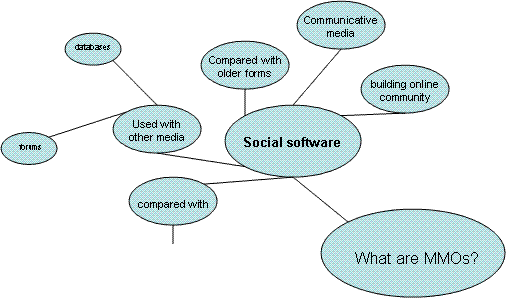
Prior to SLAIS, I never had an inkling of the importance of social software, let alone its application in LIS. Is it a radical new development? Depends on what perspective one takes. In my view, social software is nothing new: it has been in the market for a while. ICQ, Geocities, online forums & message groups, and mailing lists, just to name a few. The only difference is that it never quite got categorized under one rubric. Currently, they are repackaged as MSN, blogging, and wikis in a different form (but basically a similar function). Regardless of it being new or old, social software is a powerful tool in communication, particularly for the health sciences since up-to-second information is often crucial for health professional.

Robert S. Kennedy’s “Weblogs, Social Software, and New Interactivity on the Web” offers an intriguing discussion into the importance of Web 2.0 in the health sciences. As he contends, the online environment is undergoing an interesting evolution. Many health professionals are increasingly taking advantage of this new connectedness to experiment with expanding our intellectual and social networks.

Interestingly, he echoes something which many in the library and information circles have been arguing for years now. Blogs offer the possibility of transforming publishing and traditional media into more personal and interactive experiences in which the individual is not just a passive consumer but an active participant. In fact, blogs in medicine and the neurosciences are unique publishing tools that are beginning to have an impact, one in which it has become both personal and professional journals or commentaries that have morphed into a distinct style of communication. Amazing. And we are only on the cusp of these emerging technologies. Can you imagine how much more it will be 10 years from now? I sure can't.

Tuesday, September 12, 2006

G.S. To the Rescue


Quick! Put that muffin down! Here are the instructions. You have exactly 30 min's. You have no time to explain to the user your search strategy. You have no idea what sources your user already has in hand. And also, you are not to list the resources available. You are to search, search, and search. And come up with the most relevant articles as possible. (This isn't a reference interview). Now Go!

  • I'm writing a paper for another project I've been working on, and I'm looking for a reference or two to bolster my claim that primary care physicians are insufficiently trained in assessment/referral practices for mental health and/or substance use disorders, and that they aren't adequately integrated with specialized care professionals for these problems. I've found a couple of papers but I thought I'd check with you anyway . . . I'd much appreciate any studies you could throw my way.

What did I do? Google Scholar. Fortunately (or, unfortunately, depending on what perspective you take), when it comes down to finding a quick and dirty way of coming up with scholarly sources, Google Scholar does the job, and does it effectively. For this search, I basically had to cut down the jargon and come up with the key terms.

Because this inquiry pertains to psychology, I have to use a multidisciplinary approach. Of course, if I had more time, I may be able to use CINAHL, PubMed, Medline, or PsychInfo and play around with controlled vocabulary MeSH terms. But we're on a strict time budget! Onwards!

The terms I used were: "primary care physicians" and "mental health" and "insufficient training" and "lack." Surprisingly, despite this unscientific approach, I still came up with some useful
sources. Now, it all depends on context. If this were a reference desk search, it would probably be a terrible failure. However, in my case, it's for a researcher who desperately wants a few sources thrown her way. So, it works. Not the best way, but good enough for the moment.

I used G.S because I felt it covered a wider range of databases, compared to doing searches using just PubMed or Medline. Another reason why I used G.S. is that it's freely accessible online. Just like
PubMed, I don't need UBC access. Moreover, I also liked G.S. because of its related articles feature; it allows me to continously spread my search to articles which are similar to the one at hand. Ah yes, the power (or horrors) of Google Scholar . . .


Monday, September 11, 2006

Mission and Mountains


The upcoming "Mission in the Mountains: Believe and Achieve" is the Western MLA Chapters 2006 Annual Meeting, which will be hosted by the Pacific Northwest Chapter of the MLA in Seattle. Whereas in the past, the annual meetings had only the PNCMLA, this year promises to be the most exciting event to date since all four Western chapters of the MLA will be meeting together, including Hawaii-Pacific Chapter (HPCMLA); the Medical Library Group of Southern California & Arizona (MLGSCA); and the Northern California & Nevada Medical Library Group (NCNMLG) at a meeting hosted by the Pacific Northwest Chapter (PNCMLA) of the Medical Library Association.

Events will include presentation from speakers, continuing education sessions, roundtable luncheons, and poster sessions. (It's not too late. There's still time for signing up!)

Saturday, September 09, 2006

The Search Continues

I recently encountered one of the toughest questions to date. This one nearly blew my mind out when I first skimmed it over. Where to start? How to start? What is it? (And, what have I gotten myself into?)

We are attempting to build a scale out of our
Attitudes and Expectancy data. A starting reference point is Brown, Christiansen and Goldman 1987 – Journal of Studies on Alcohol Sept. 48(5), 483-491.


If these references fully explain the methodology for the development of the Alcohol Expectancy questionnaire, you can move on to…

Other attempts at building an expectancy profile exist around the Iceberg Profile – from the Profile of Mood States questionnaire.

You can also look at scale development in Item Response Theory information…http://en.wikipedia.org/wiki/Item_response_theory

We are looking for scales that have been developed in the exact same way as we hope to, and/or the Alcohol Expectancy Questionnaire was developed.

After a few gin & tonics, and some LIS training and search experience under my belt, I thought it would be interesting to take this on as an information professional at the ref desk. Here is what I did: (1) Find the article. Read it. Analyze it. I used PubMed, which has a "single citation match" feature which allows us to enter a the author's name, volume, issue, and page number to find the article, if a title is not provided. And wouldn't you know it, PubMed indeed came up with the title I needed, plus an abstract!

(2) I then moved onto the the UBC Library Subject Guides. The challenge is that the multi-disciplinary nature of the topic at hand. My first inclination is to start off in Psychology. Yet, other life sciences topics are equally pertinent (i.e. nursing and social work). Even within medicine, different disciplines are relevant.

(3) Thus, starting with PsychInfo, I eventually cover what I feel are the other main indexes & databases: CINAHL, Embase, Medline, and Web of Science. I also cover the free online databases: Google Scholar, SCIRUS, and Tripdatabase. Interestingly, Academic Search Premiere, a multidisciplinary database proved to be one of the most useful as numerous useful hits came up.

(4) With the search tools mapped out, the next step is to come up with some search terms. It took quite some experimentation, using many different combinations of terms. But in the end, I used (1) "alcohol expectancy questionnaire" and "scale development". (2) "Iceberg profile"; (3) "profile of mood states questionnaire" and "scale development"; (4) "Item response theory" and "scale development". Some interesting results did come up. Any ideas on how to improve upon this fairly rag-tag approach?

Allan's Library Blog 2.0

And we're off! Change for this blog has forever been at the back of my mind throughout the latter stages of the summer; I've been planning how to establish a new look for quite a while. (Not to say that the previous design wasn't adequate -- it was time for a change). Here's the push that paved the way for this to be done: LIBR 534 - Health Information Sources and Services, a course which I am taking at the moment. It was exactly the spark that was necessary for igniting this change to hopefully a bigger and better, more informative web log. Hence, my upcoming blog entries will have a more health information-related theme.

For my first posting, I'd like to go historical and introduce Andreas Vesalius, who was an anatomist and author of one of the most influential books on human anatomy, De Humani Corporis Fabrica (translated, it is "On the Workings of the Human Body"). This expensive piece of work can be found at UBC's Woodward Biomedical Library's Charles Woodward Memorial Room.

Thursday, September 07, 2006

It's here! (Finally)


Something looks different with Google Scholar. I had a quizzical frown when I made a search on Google Scholar. Along with the usual result hits was a "related articles" feature which look surprisingly similar to PubMed's. While its citation analysis feature matched Web of Science's, Google Scholar had always lacked a function which allows searchers to find related articles.

But it's here now! And it's here to stay! The searching just got a little easier, and much more comprehensive. To read more, you go to Google's Blog for further analysis. http://googleblog.blogspot.com/2006/08/exploring-scholarly-neighborhood.html

And if you look closely, Google's blog has linked this posting. Amazingly, it only took a few hours for them to crawl it, too.

Thursday, August 31, 2006

Google Scholar for the Humanities and Social Sciences

It's training week as a Graduate Academic Assistant at the Humanities and Social Sciences Division at UBC's Koerner Library. My interviewers at HSS weren't kidding when they asked me if I was prepared for boot camp during the last week of August. They were smiling when they said it, and I naively assumed they were facetious. How wrong I was!

The training has been wonderful though; it's enough to last me for the next few jobs. While I've been introduced to the wide array of areas and subjects of HSS librarianship, including maps & atlas, government publications, journals and microforms, and even numeric data files, nothing could prepare me for the reference desk training, which has been gruelling to say the least (but very educational).

One very special tool that I had taken away with me from my library and research experience at the Biomedical Branch Library at VGH, Hamber Library at the Children's and Women's Health Centre, as well as the Centre of Applied Research for Mental Health and Addictions has been my experience working with PubMed and Google Scholar.

First, Google Scholar. One handy little skill that I've picked up is finding articles which have incomplete citations. By simply typing in part of the title (with quotations around it), chances are that the article or abstract will be available. And from a campus networked computer, the link might even have full-article access via e-link. Prior to Google Scholar, this was mainly possible only through Web of Science, which was limited to the Sciences. However, Google Scholar has opened the door (if only ajar) for the humanities and social sciences.

Second, PubMed. To date, there is still no tool in the humanities and social sciences which can compare to the amazing usefulness of PubMed's ability to search for incomplete citations. At GAA training, we're taught to use a variety of methods, from going to Subject Guides to consulting Wikipedia when searching for articles with incomplete or incorrect citations. However, in the health sciences, one can simply enter the author and page number or year of publication, and voila: the article can be retrieved quite easily, and often with links to similar articles. As I am perfecting the art of searching, I keep hearkening back to PubMed and wonder, wouldn't it be more effective if we also do the same for other subject areas? With so many database vendors (Ebsco, Wilson, Lexis Nexis) all in dire competition with each other, I doubt that there will be a day when one database will do it all. Or am I wrong?

Friday, August 25, 2006

Demise of LIS?

The recent announcement of the dissolution of the School of Informatics at the University of Buffalo is another example of the marginalization of the profession and discipline of Library and Information Science. Its abandonment isn't the first, nor will it be the last.

Why are library schools still being closed down even though the need for information specialists continue to rise? Is it the stale image of the librarian? Is it the measly wages? Regardless of the reasons, academia seem to enjoy pushing LIS programs around. (Michael Lorenzen's "Education Schools and Library Schools: A Comparison of Their Perceptions by Academia" offers a fascinating analysis). In the ugly case of the LIS program at Buffalo, it was first the merger with the Department of Communications in 2001, then now, the arbitrary insertion into the Faculty of Education. It's gotten so bad that the library school barely passed ALA accreditation (it's been given a "conditional" status).

When will the madness stop? It's time for information professionals to stand up and do something.

Sunday, August 20, 2006

Good to Great


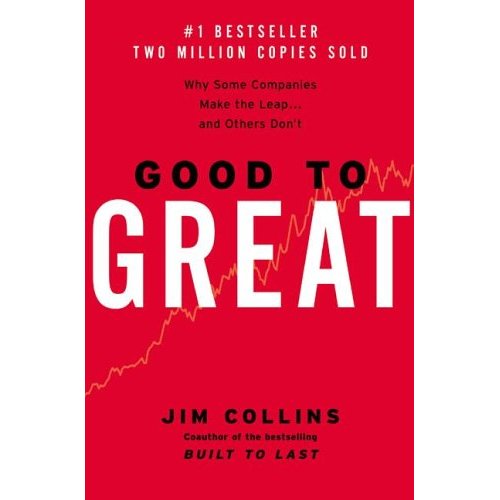
If there's but one business book you ever read in your life, Good To Great should be on the shortlist. Jim Collins, a former Stanford Graduate School of Business professor and his research team discovered that there are seven similarities that all successful organizations encompass. I highly recommend this book because its points are relevant to not only for profit businesses, but also libraries and similar organizations. Here are the books main findings:

(1) First "Who", Then "What" - Hire the right people, then formulate a plan. It sounds strange, but based on his research of American companies, Collins unveils the fact that all the successful ones are run by Level 5 Leaders, humble individuals who put their organizations before themselves, who would do anything and everything to achieve success for their company, not for themselves. Although they are often shy and humble, they possess steel determination to get things done. Such people will recruit similar individuals; moreover, once the team is created, the leader will set up their successors for even greater success in the next generation.

(2) Confront the Brutal Facts (Yet Never Lost Faith) - Success is not achieved in one day. All successful companies were built over a long stretch, day by day, bit by bit. Using the Stockdale Paradox an analogy, companies that drop out are those who are most optimistic, who often base their strategies on lofty goals within shortest timeframe possible. The successful ones don't use a clock to time progress; they use patience and faith, never knowing when they'll achieve success, but only that it will happen eventually.

(3) The Hedgehog Concept - When the right and patient people are on board, only then can a plan be formulated. Taking Isaiah Berlin's analogy of the hedgehog and the fox, in which the "The fox knows many things, but the hedgehog knows one big thing," Collins argues that great companies have one idea and sticks by it no matter what, whereas mediocre organizations are all over the map and changes directions on a dime.

(4) A Culture of Discipline - When there is discipline, hierarchy is no longer needed. With disciplined thought, the same goes for bureaucracy. Hence, the best companies are those with employees who are hardworking, respectful, and ultimately enjoy what they are doing.

(5) Technology Accelerators - Great companies think differently about the role of technology. They never use it ignite transformation; rather, they apply technology to forward their hedgehog concept, the big overall plan.

(6) The Flywheel and the Doom Loop - Success cannot occur like a revolution; there is never a "defining" miracle moment. Instead, it happens in small increments (like a wheel), turn upon turn, and building momentum slowly and steadily.

(7) Built to Last - Success and greatness are not defined by money. Instead, the goal is intrinsic excellence, simply creating something so that it can endure and be meaningful at the same time . Hence, I find the book intriguing because it is not only limited to businesses. It can be applied to any type of organization. It's worth a read, even if one is not looking to build a corporate dynasty.

Wednesday, August 16, 2006

The Informationist of the 21st Century


Things are coming together. And a session for UBC Pharmacy residents titled, Search skills for UBC pharmacy residents:Appraised tools, PubMed and even Google provided the perfect capstone. What I had originally anticipated as a teaching session turned out to be much more than I had expected, for the 2.5 long session gave me greater insight into the role of the information professional within the entire rubric of the field of health science and medicine.

Things finally make sense now. I must say I disagree with Pharmacists and Reference Librarians, a blog entry that had confounded me when I first encountered it a while back ago. It argues that the reference librarian is not far off from the pharmacist, for both have lost their relevance - the librarian to search engines while the pharmacist to the retail drug companies.

But that is a gross overstatement. If anything, working in two different hospital libraries as well as a health science research centre has given me the knowledge, experience, and skills to confidently say that the information professional plays a huge role. First, a project at CARMHA on primary care, revealed that pharmacists are on the often on the "front lines" of healthcare, for they are often the first to be consulted by patients with medical inquiries. Pharmacists are much more than mere pill counters. And second, introducing an academic to Google Scholar proved to be not only a humbling experience, but also a reminder of how far off we are to being a truly "information society."

With evidence-based medicine (EBM) ever so important in the health professions, pharmacists are needed and expected to have solid information searching and retrieval skills. This is where the librarian/information professional comes in. We not only find information and teach others (such as pharmacists) information literacy, but we also have a mandate to keep up to date with new findings and techniques on such new technologies. Hence, how can one not vehemently rebuke that pharmacy is "just a bit further along the road to annihilation than librarianship is"? It's perhaps appropriate for the informationist stand up and take a bow.

Sunday, August 06, 2006

If You Build It, They Will Come


What makes a “good” post-secondary institutional library? Is it the collections? The atmosphere? Or the photocopiers? Unfortunately, students rarely (usually never) visit libraries to attend a teaching session by a particular librarian as they would for a well-published academic professor. Frade and Washburn’s recent article, The University Library:
The Center of a University Education?
studies the recent trends of how the library is being used by its patrons.

Not surprisingly, numbers are down: there are simply less people walking through the gates. The survey reveals that two core library services, instruction and reference, were ranked very low in terms of patron’s importance. Rather, the study found that patrons came to the library for study, using the internet and computer labs, copy machines, courtesy phones, and signing out books.

In the second part of the research, the study found that two services increased the usage of the library: (1) extended hours; and (2) the implementation of an Information Commons. Interestingly, usage statistics increased during the extended hours, particularly in the area of the IC’s, where there are multimedia computer workstations and plenty of study space are located.

The study doesn’t surprise me much. The library will always be the core of the academic institution. Perhaps times have changed. Although reference and instruction may not be as highly regarded as in the past, that doesn’t render the library and the librarian as ineffective. Far from it, the library will forever be a place where learning and quiet study takes place. As many institutions are advocating cutting back hours to keep costs intact, the library seems the most convenient scapegoat, and hours are particularly the easiest to lop since apparently the numbers are down.

But are they? As this study shows, perhaps more emphasis needs to be placed on tracking when patrons are entering the gates. Unlike bookstores, which keeps statistics on hourly gate counts, most libraries do not (not even the big ones). Just cutting back the hours without careful consultation is clearly a costly mistake, for both the patron and the library itself.

Saturday, July 29, 2006

The Future Library or Traditionalist Paranoia?


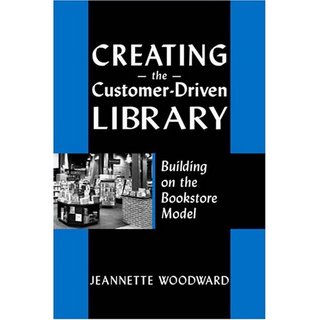
Jeannette Woodward's Creating the Customer-Driven Library: Building on the Bookstore Model offers fascinating insights into the emerging bookstore-concept library. Woodward argues that, for the library to not only survive, but thrive, it must adapt to the retail bookstore model of tailoring services and products to the tastes of the patron. The Richmond Public Library has adopted this philosophy almost to the tee. However, what makes it unique also makes it controversial. Here's why:

(1) Customers service - The RPL prefers "customer" over "patrons." It's all semantics, but behind this innocuous phrase is a pure concept of pleasing the person who steps through the gates. In a way, is not every library's mandate essentially the same, particularly for "public" libraries?

(2) Merchandise - Calling books "products" seems weird, but referring to them as "merchandise" might be ludicrous for some. Put it any way you like, a duck is a duck. Quack, quack. Nonetheless, language does make a difference in the way human cognition operates. By focusing on promoting the items in the library, it does highlight the importance of what is at stake. Is it a bad thing to "sell" what you have?

(3) Self-service checkouts - 95% of the circulation is done by self-service automation. Even holds are self-service. Understandably, traditionalists are upset that such a trend will ultimately displace the library staff, namely the paraprofessional and support staff. The RPL disagrees. It believes that such a system frees up staff to do other customer-service tasks.

(4) "Walking the floor" - In adopting this retail concept, the customer will always be served and the products continually replenished. Staff members are to proactively walk around the stacks and offer assistance to those in need. However, at the RPL, this is the case for certain sections, namely the Popular Titles section, where it is an amazingly dynamic area of the building.

(5) Automated scheduling - Democracy or pseudo-outsourcing? Call it what you will, by allowing auxiliary staff to pick and choose their own schedules, the RPL allows ultimate flexibility. But why not just hire more full-time staff instead of piecemeal? By doing so, the RPL argues that it maximizes on the full potential of its open hours (it has the longest hours of any public library system in North America). But does it to save in other areas?

(6) Themes - To a certain extent, this is not new. However, RPL takes it to another level, and offers new themes regularly, such as "Asian Reads" or "Biography Lovers." In such themed areas, books are picked off the shelves and placed together.

(7) Outsourcing of cataloguing - RPL doesn't create its own catalogues. Nor does it even copy-catalogue. Everything is done by contract. Does it work? Well, it does free up the essential revenue for other areas, such as the latest DVD's and more newer titles. In the end, the question is, does the customer/patron benefit?

(8) Reference - The traditional reference desk, where the librarian snuggly sits for hours on end, quietly working away on the computer is replaced by Information kiosks.

(9) Signage - Not unlike bookstores, RPL's sign are sharp and attractive. The signs say it all. "Kids Place" replaces the traditional Children's section. Is it a sellout to the bookstore? Or are we simply using a good, simple idea and applying it to the library?

(10) Coffee machines - Traditionalists cringe at the thought of drinking in the library. However, RPL promotes it by having machines right inside. Although somewhat teleological, Woodward argues that since patrons are going to drink/eat at home with the books, we should perhaps be at peace with the inevitable.

So far, RPL has been very successful. In my opinion, location is everything. Gate counts are one of the highest in Canada. Yet, what works in Richmond might not work in Abbotsford or Victoria. The demographics in Richmond make sense: young, hip, urban, and middle class. The sleekness of the RPL suits such a chic clientele. But will such a model last? Time will tell.


Friday, July 28, 2006

Email: Beware. . . or at least be careful

"Why then, can one desire too much of a good thing," says Rosalind in As You Like It. How true Shakespeare's words still ring! Although information professionals are relied upon to find and retrieve timely and accurate information, they are ironically at risk of running into occupational hazards, personally and professionally.

Why do you ask? Besides addiction (which deserves a future blog posting upon itself), email messages can easily be misinterpreted and written out of context. Tom Van Vleck's "The Risks of Electronic Communication" offers an excellent "how to" guide on how to properly use email. I've summarized his salient points.

(1) Jokes. What appears lightheartedly humourous may offend others. People are more offended by offensive jokes through emails than through in-person commentaries.

(2) Anger. Emotions run high online. Without reading them carefully, emotional messages can trigger strong emotions from the recipient, often taken out of context (by both sides). Hence, the solution? Pick up the phone!

(3) Sarcasm and Irony. Some people read hastily; others just take words literally and don't understand that you really meant the opposite of what you wrote. As Van Vleck warns, even a smiley or "just kidding" won't always work.

(4) Criticism. Don't do it online, even if temptations run high. Even criticism of trivial matters can be construed out of context. People are touchy; if they feel attacked, they attack back.

(5) Late Night. I like this one the most: messages composed late at night can cause serious damage. As Van Vleck points out, some mysterious influence of the brain gets triggered after a certain hour, 9PM or so, which makes us think we're typing in sensible messages, when in fact they are subject to severe misunderstanding. Hence, the best solution is to save it in a file and look at it tomorrow morning. (Guilty as charged!)

(6) Personal Remarks. Making derogatory remarks about others is a bad idea. Doing it behind their back is worse. Doing it in public is deadly. Electronic messages are the last place for any kind of uncomplimentary remark. Sometimes, that FWD can turn into a REPLY, and hence, the nasty email remark gets sent to the very person you don't want reading it. (Guilty again!)

Hence, for the information professional, "handling" information/records is every bit as essential as searching, organizing, and disseminating. Perhaps it's time that proper usage of email be included somewhere in the LIS core? Have we taken email for granted, perhaps blinded by its supposed simplicity when in fact its more complicated than we realize? Amazingly, Van Vleck's article, written 11 years ago, is still as relevant as it is today as it was then, if not more so. If I had only read it when it first came out, I would be so much better off!

Sunday, July 23, 2006

Open Access, Open Search, and Social Tagging

It's summer, and with the heat, ideas too can melt and meld together into a mishmash of incoherent mess. Recently, I've been introduced to a variety of online tools. With some reflection, I believe that three "trends" if we can call them that, have emerged from online environment which are highly relevant to the information professional.

(1) Social tagging - Flickr, Del.icio.us, Wikipedia, and Library Thing are but a few of the online tools for which users can freely search for information (an items) through the creation of hyperlinks without the constraints of controlled vocabulary or rigid taxonomy structures. Anyone and everyone can create his or her own terms, post them, and share them other users. The question is, is such social tagging (ethnoclassification, folksonomies, or collaborative tagging) a new thing? Or is it an outgrowth of an existing online world which we've been using all along since the inception of the internet? Only now, we have terms for them.

(2) Open Access - Journals are slowly integrating themselves into the online world. Open Access is perhaps one of the hidden gems of the internet that is slowly emerging as an important tool in the academic/professional community. Library Student Journal, Journal of the Association for History and Computing, and Biomedical Digital Libraries are but an inch of the light years of open access journals readily available for perusal. Yet, recent controversy surrounding open access is just how "open" is it? Some journals charge its writers for a fee.

(3) Open Searching - Pubmed is one of the shining examples of how collaboration can open up the world of information to users in need. It's a matter of time, that it opens up to other avenues beyond the health sciences world and into the humanities, social sciences, and business. It still intrigues me the shroud of secrecy in the legal world, where Lexis Nexis and Westlaw charge the users by the minute. Although it does promote the librarian to a higher status of importance in the particular locale, does it not make an intriguing contrast with the "openess" of Pubmed?

So with this said, the question remains, is the librarian useful in this online world? Ab-so-lute-ly. As an information professional, librarians are perfect for such fact-finding and information searching missions. Not only do librarians have the knowledge of cataloguing/classification essential for a deeper understanding of how information is organized, they also have the social skills (and interest) to help users look for what they are searching for -- they're good at customer service! Because if you think about it, the online world is a jungle, and librarians are trained to sort through all that mess.

Wednesday, July 12, 2006

Librarians and Teaching Styles


Before entering the MLIS program at UBC, I had never realized how important teaching is in librarianship. Today, I had the chance to see one librarian in action, and it was fascinating to analyze his teaching rather than on his teaching content. On top of the usual core competencies of LIS (bibliographic control, refence, management, collection development, and info technology), I would add teaching as part of the mix.

Because there are numerous teaching styles, there can not be "categories" that cleanly and clearly define such styles. (Although, in Confucius' case, his disciples created several schools of thoughts based on different interpretations of their master's teachings).

Regardless of styles, or different schools of thought, teaching is an integral part of the librarian's work. He must not only present the material in a coherent manner, but also be engaging to his audience at the same time. In fact, teaching for librarians is probably more difficult than "traditional" teachers such as college professors, high school and elementary teachers. Whereas these teachers have a fairly predictable group of students, librarians have to constantly adjust and tailor their teaching styles according to their different audiences. For example, the approach that a librarian takes when teaching a class of undergraduates how to use databases might be completely different than how they teach a group of university professors how to start a weblog account.

A valuable and intriguing website for any information professional interested in improving his or her teaching skills is LibraryInstruction.com, which offers great lesson plans.

Thursday, July 06, 2006

Leadership and Management

Recently, a librarian manager discussed with me his managerial philosophy. Managing people has always piqued my interest, as I see it as a combination of teaching, parenting, and coaching. Incidentally, I came across a fascinating article, Leadership or Management: Expectations for Heads of Reference Services in Academic Libraries, from Reference Librarian which nicely delves into the issues that we were discussing. (The same Volume: 39 Issue: 81's issue offers other articles related to the topic of library management).

In the organizational hierarchy, the most difficult position is the “front-line manager” who are the lower-level managers who supervise the operational activities of the library. Although it can be seen that they serve as the link between the management and the non-management staff, it can be construed that they are often squeezed into unenviable positions, making decisions which pleases neither the top nor the bottom.

Unaeze argues that management and leadership are not the same. While management plan budgets, organize the staff, solve problems, and provide stability, leadership requires establishing direction, motivating people, and producing change. A list of traits are analyzed, such as courage, decisiveness, flexibility, and time management.

I’ve had some super bosses but also have had mediocre ones. As important as Unaeze’s points are, my experiences offers some observations of management from the employee's perspective.

(1) Humour – Laughter often brings out the best in us. I find that using humour – even if the punch line fails – generates morale and eases the burden of the workday. The best bosses I’ve had (as well as teachers) have been those who took the time during breaks to come out and crack a few jokes, talk about the missed penalty, or just how wonderful a movie Back to the Future was.

(2) Trust – Managers don’t always need to be judicial. Sometimes, discrete should be traded in for a good chat with employees. It fosters trust. Of course, confidential discussions will be always be at risk, but as the saying goes, with high risk comes high rewards.

(3) The Human Touch – The best managers I have had are those who show their vulnerabilities. Cynicism, despondency, animosity are what makes us all common. I am often touched after personal chats with the supervisor, or when he or she spills a few personal anecdotes about the roadblocks that he or she faced along the way. With humility comes communication, and with that, a better, more motivated team.

(4) Hardwork – Even if the manager is not working on a task, he must appear as if he is, just for the sake of the team. Motivation and example come from the top, and if the leader doesn’t show it, then the staff is doomed to follow. I once had difficulty cutting some tape for urgent delivery from a busy retail bookstore. The manager brusquely took it out of my hand, sheared it with her own teeth, then resumed whatever task she was doing. Job done, problem solved. The experience left an indelible impression in my mind; it helped me realize that managing isn’t just about conceptualizing and brooding in a spacious office.

(5) Generosity - As the author Robert Kiyosaki once said, if you want to make money, you also have to give away money. And do it all without the expectation of any returns. Hence, I truly believe the best managers are those who are not shy to divulge "secrets of the trade" to others, and I most admire those who take on mentorship roles. In a profession which relies on information exchange and dissemination, what better way than to multiply your own information gathering talents?

Wednesday, July 05, 2006

The Scholar versus the Invisible

In refuting the findings of Bergman’s size of the unreachable areas of the internet called the “invisible web,” Exploring the Academic Invisible Web argues that that no single library alone will be able to index the invisible web, let alone the Academic Invisible Web (AIW).

The article’s arguments are interesting when used to analyze the effectiveness of search engines, such as Google and its counterpart, Google Scholar. In the author’s opinions, the AIW can be effectively indexed only through cooperation of portals, that is, combining Google with Scirus, BASE, and Vascoda. Only by balancing the strengths and weaknesses of each can the AIW be properly mined.

The article offers a fascinating complement to a recent article, The Depth and Breadth of Google Scholar, which argues that one of Scholar’s weaknesses is its bias towards the sciences. However, that is just the tip of the iceberg; here are others:

(1) Broken Links – What makes Google strong also makes it weak. While citation analysis offers integrity to its sources, it unfortunately has a “blindspot” to sources that are single-paged entities which are put up on the internet solely not for linkage. There are numerous pages like this on the so-called “invisible” web, which Google does not catch, while others such as Yahoo! might.

(2) Currency - While Google Scholar has a plethora of sources, not all of it is recent. In fact, it might be detrimental for the health sciences if new discoveries are left at the bottom of the pile because they are not as cited as much as the older documents.

(3) Law of Diminishing Marginal Utility – With information saturation, the tradeoffs are up to the user’s needs, and requires Rangananthian philosophical debate to resolve. While Google provides a great deal of information, it requires users themselves to sort through the mass of information.

(4) Indexing – Although citation analysis is reliable, there is still too much grey literature floating in cyberspace. Until Google can somehow reach into these areas, it is still an incomplete tool. One possibility is its emulation of the Dublin Core, which can create a generic uniformity for everything posted on the internet. Although only apipedream, imagine the possibilities!

As someone once commented, relying Google for critical information can be like using an “axe instead of a scalpel” in surgery. Although it cannot replace the librarian professional, it does offer a nice complement to the team.

Friday, June 30, 2006

All the World’s a Stage


One thing I learned about librarianship is the amount of responsibilities and different roles required for this profession. Recently, I read A Dramaturgical Perspective on Academic Libraries, which makes a fascinating comparison between libarians and performers. In it, Brian Quinn points out that dramaturgical theory has 6 themes which relate to the library:

(1) Performance – a librarian is always an acting, from answering reference questions to directing staff meetings. In the library, he plays the role as information gatekeeper, but outside of the facilities, he is a son, father, husband, and/or multiple other roles. It is interesting though that the higher the position in the administration hierarchy, the greater the performance is required.

(2) Teamwork – All plays need a cast, and such is the case with libraries. Librarians often help each other out with reference questions when they are stuck, very much like an actor who helps out with an awkward pause when another player has forgotten his or her line.

(3) Regions – Performances take place at the “front,” and in the case with libraries, the circulation desk. The “backstage” is where players are out of view of the audience, and in the library is usually technical services (e.g. cataloguing) and the staff lunch room. What is most fascinating is the “make work” role-playing, where librarians are supposed to appear as if they are working even though they are playing sudoku on their computers, looking busy as if they are at work when in reality they are just “phasing out.”

(4) Other roles – Librarians and users often play roles outside of their realm and not in the script. For example, librarians might clean up after a flood even if this is not written in the contract; however, this is a duty that he must perform for the play to function.

(5) Communicating out of order – Even the best librarians cannot be in their roles 24/7. Hence, it is not uncommon for them to talk “out of character” with expletives and loose their cool from time to time.

(6) Skilled Performers’ Attributes – Loyalty, humour, thinking on one’s feet. Ah yes, the questions that interviewers ask. The skills for success in performances are often the very ones required of librarians. If a rowdy patron stirs up trouble by refusing to leave during closing time, much like an audience member who heckles the actors during the play, it is ultimately the skilled librarian who defuses the situation with as little damage and notice as possible.

Thursday, June 29, 2006

The MLS as Union Card?

I recently came across Phillip Jones and Jamie Stiver’s Good Fences Make Bad Libraries: Rethinking Binary Constructions of Employment in Academic Libraries in Portal, a wonderful Open Access journal. The article is illuminating in that it adds another layer to the professional vs. paraprofessional discourse in the world of librarianship. The article disputes some of the arguments made by previous scholars. Jones and Stivers make some fine arguments which, in my opinion, should be required discussion for every intake of LIS students.

(1) Is the “bifurcate model” which pits the professional librarian with the paraprofessional member(s) of the library still sustainable? The authors argue that in our post-industrial world, defining librarianship by minimalizing paraprofessionals is “tragicomic.” Instead of pettily bickering over the exact duties of job positions, we should focus on teamwork for the information environment to function properly. What is the point of arguing if you can't even get the job done?

(2) Librarians are not doctors. Arguments have been made that librarianship is a profession very much like law or medicine or accounting. But no, the authors take this grand argument back to reality, and argues that it is unfair to put librarianship in the same rank with doctors. We are professionals, but let’s leave it at that.

(3) The “Fence” has to be put down. There seem to be unwritten rules all around us which rebuffs paraprofessionals from entering the “librarian” world. One example is fees for participating in professional associations. While LIS students can pay lower fees, non-library professionals and students are either refused entry or forced to pay higher remittances. This is clear discrimination.

(6) Unfortunately, Stivers and Jones does not add to the fray with any fresh solutions or alternatives. Rather, they admit that they prefer to remain “on the fence,” arguing that librarianship is one of “responsibilities” versus “tasks.” Although librarians perform many of the same routines as their library assistants and staff do (e.g. taking out the garbage or answering the phone), at the end of the day, the librarian is ultimately charged with the responsibility of managing the library.

Although an MLS does not a good librarian make, it is unfortunately the only credential which is currently available which sets apart the professional and paraprofessional. To use a crude analogy, many pursue an MBA not because they are more diligent than their peers, but because they are ambitious and enjoy future challenges. In order to do so, they need the proper “networking” and training to do so. Whether they really become competent managers is really determined on the job.

The question is thus, is the MLS an MBA? Yes and No. Once on the job, let the curriculum's training of the so-called "professional" do the real talking.

Thursday, June 22, 2006

The Never Ending Wonders of Google

I followed up on Google Scholar with an article I came across by James Caufield, Where did Google Get Its Value, which is not only fascinating and thought-provoking, but also forced me to think of the search engine within the library domain, not as a complement to the electronic and hardcopy collections, but ultimately as a "predecessor" of Google.Whether Google's success is based on the shoulders of librarianship is certainly up for debate (one in which I'd like to reserve front row seats for), it does offer food for thought in how we use and perceive Google and search engines. Here is what Caufield says are the strengths and weaknesses of Google:

Strengths
(1) Better Indexing – As Caufield argues, “Google brings a library value to the web environment [by] improved access through better Indexing." I'm certainly much more enlightened now on the mechanics of how Google works. (So that's what separates Google from the rest. . . ). Indeed, while other websites blindly ranks the relevance/importance of a website based on the number of key terms that a website has, Google uses a unique algorithm that ranks webpages based on the links that it has to other relevant websites. In many ways, this is almost as if the internet is "peer-reviewed," and relevance is constantly upheld by other websites. Whereas websites can get away on other search engines by simply padding their websites with any key terms to cover the wide spectrum of subjects, Google restricts this practice. If you highlight the rest of this line, you'll know what I mean. (See, you use the entire dictionary just to fill up entire pages with words! How ingenious yet devious!)

(2) Better Access through Simple and Disinterested User Interface - Instead of urging the user to stay within the same page for the purposes of advertising and data collection, Google erased this questionable practice when it introduced its plain and simple search engine box. What this did was improve access, and allowed the user to obtain information in a much timely fashion. (In other words, it made thing quick and tidy).

(3) Google Brings the Library Value of Unbiased Selection to the Web Environment - Unlike other web search engines, Google didn't accept any advertising fees. (Hence, the simple user interface). What this did was that content from its searches were uncorruptable, since all materials were on equal footing -- one didn't and couldn't pay money to get material slotted to a higher ranking.

(4) Google Produces Better Access through Uncorrupted Indexing - With some controversy, Google also "punishes" websites that try to manipulate and break the Google PageRank algorithm. So-called Search Engine Optimization plays by Google's rules and increases the ranking of webpages by creating inbound links. However, Google counters such moves by manipulating its own algorithms to match that of culprits. But in the end, who manipulates who? And at what cost? As the Machiavellian conundrum goes, "Does the end justify the means?"

(5) The Reference Interview - This one caught me offguard. However, Google apparently processes a reference transaction very much like a librarian by having cookies attached to every user. By having a history of the searches made by a user, Google has a better and more focused understanding of the user's need.

Negatives
(1) Privacy! - Not surprisingly, with cookies come problems of privacy. Indeed, one can see how Google can keep track of search histories simply by having it up on the RSS feeds. It's widely available for anyone to see his or her own searches. Which is nice if one is comfortable with it; however, if users share the same computers (or is unaware that they are), then privacy issues can certainly emerge.

Yahoo!
Interestingly, I have not been entirely aware of the conveniences of Google until only quite recently. For years, I have preferred Yahoo.com due to its familiarity (it's been around since 1994). While countless search engines have come and gone, Yahoo! has always stayed faithfully by my side throughout my online experiences. Moreover, not only has it been quite consistent with its user interface throughout its existence, it has a handy indexing system that separates different subjects for the user - not that anyone really uses it. . . ) But nonetheless, Google is the preferred choice of most users, and it seems as if it is here to stay for quite a while. Which leads me to a short anecdote. During an interview, the librarian asked me what search engine I prefer using. Naturally (and naively) I stood up for Yahoo! However, my reasoning was illogical in that I admitted that I liked it for nostalgic purposes. Hindsight is always 20/20, but if I had another chance. . .