Wednesday, August 16, 2006

The Informationist of the 21st Century


Things are coming together. And a session for UBC Pharmacy residents titled, Search skills for UBC pharmacy residents:Appraised tools, PubMed and even Google provided the perfect capstone. What I had originally anticipated as a teaching session turned out to be much more than I had expected, for the 2.5 long session gave me greater insight into the role of the information professional within the entire rubric of the field of health science and medicine.

Things finally make sense now. I must say I disagree with Pharmacists and Reference Librarians, a blog entry that had confounded me when I first encountered it a while back ago. It argues that the reference librarian is not far off from the pharmacist, for both have lost their relevance - the librarian to search engines while the pharmacist to the retail drug companies.

But that is a gross overstatement. If anything, working in two different hospital libraries as well as a health science research centre has given me the knowledge, experience, and skills to confidently say that the information professional plays a huge role. First, a project at CARMHA on primary care, revealed that pharmacists are on the often on the "front lines" of healthcare, for they are often the first to be consulted by patients with medical inquiries. Pharmacists are much more than mere pill counters. And second, introducing an academic to Google Scholar proved to be not only a humbling experience, but also a reminder of how far off we are to being a truly "information society."

With evidence-based medicine (EBM) ever so important in the health professions, pharmacists are needed and expected to have solid information searching and retrieval skills. This is where the librarian/information professional comes in. We not only find information and teach others (such as pharmacists) information literacy, but we also have a mandate to keep up to date with new findings and techniques on such new technologies. Hence, how can one not vehemently rebuke that pharmacy is "just a bit further along the road to annihilation than librarianship is"? It's perhaps appropriate for the informationist stand up and take a bow.

Sunday, August 06, 2006

If You Build It, They Will Come


What makes a “good” post-secondary institutional library? Is it the collections? The atmosphere? Or the photocopiers? Unfortunately, students rarely (usually never) visit libraries to attend a teaching session by a particular librarian as they would for a well-published academic professor. Frade and Washburn’s recent article, The University Library:
The Center of a University Education?
studies the recent trends of how the library is being used by its patrons.

Not surprisingly, numbers are down: there are simply less people walking through the gates. The survey reveals that two core library services, instruction and reference, were ranked very low in terms of patron’s importance. Rather, the study found that patrons came to the library for study, using the internet and computer labs, copy machines, courtesy phones, and signing out books.

In the second part of the research, the study found that two services increased the usage of the library: (1) extended hours; and (2) the implementation of an Information Commons. Interestingly, usage statistics increased during the extended hours, particularly in the area of the IC’s, where there are multimedia computer workstations and plenty of study space are located.

The study doesn’t surprise me much. The library will always be the core of the academic institution. Perhaps times have changed. Although reference and instruction may not be as highly regarded as in the past, that doesn’t render the library and the librarian as ineffective. Far from it, the library will forever be a place where learning and quiet study takes place. As many institutions are advocating cutting back hours to keep costs intact, the library seems the most convenient scapegoat, and hours are particularly the easiest to lop since apparently the numbers are down.

But are they? As this study shows, perhaps more emphasis needs to be placed on tracking when patrons are entering the gates. Unlike bookstores, which keeps statistics on hourly gate counts, most libraries do not (not even the big ones). Just cutting back the hours without careful consultation is clearly a costly mistake, for both the patron and the library itself.

Saturday, July 29, 2006

The Future Library or Traditionalist Paranoia?


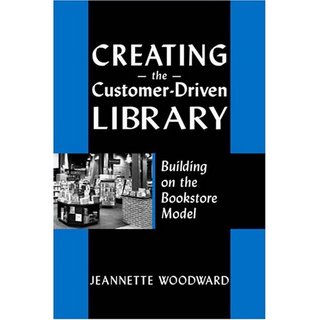
Jeannette Woodward's Creating the Customer-Driven Library: Building on the Bookstore Model offers fascinating insights into the emerging bookstore-concept library. Woodward argues that, for the library to not only survive, but thrive, it must adapt to the retail bookstore model of tailoring services and products to the tastes of the patron. The Richmond Public Library has adopted this philosophy almost to the tee. However, what makes it unique also makes it controversial. Here's why:

(1) Customers service - The RPL prefers "customer" over "patrons." It's all semantics, but behind this innocuous phrase is a pure concept of pleasing the person who steps through the gates. In a way, is not every library's mandate essentially the same, particularly for "public" libraries?

(2) Merchandise - Calling books "products" seems weird, but referring to them as "merchandise" might be ludicrous for some. Put it any way you like, a duck is a duck. Quack, quack. Nonetheless, language does make a difference in the way human cognition operates. By focusing on promoting the items in the library, it does highlight the importance of what is at stake. Is it a bad thing to "sell" what you have?

(3) Self-service checkouts - 95% of the circulation is done by self-service automation. Even holds are self-service. Understandably, traditionalists are upset that such a trend will ultimately displace the library staff, namely the paraprofessional and support staff. The RPL disagrees. It believes that such a system frees up staff to do other customer-service tasks.

(4) "Walking the floor" - In adopting this retail concept, the customer will always be served and the products continually replenished. Staff members are to proactively walk around the stacks and offer assistance to those in need. However, at the RPL, this is the case for certain sections, namely the Popular Titles section, where it is an amazingly dynamic area of the building.

(5) Automated scheduling - Democracy or pseudo-outsourcing? Call it what you will, by allowing auxiliary staff to pick and choose their own schedules, the RPL allows ultimate flexibility. But why not just hire more full-time staff instead of piecemeal? By doing so, the RPL argues that it maximizes on the full potential of its open hours (it has the longest hours of any public library system in North America). But does it to save in other areas?

(6) Themes - To a certain extent, this is not new. However, RPL takes it to another level, and offers new themes regularly, such as "Asian Reads" or "Biography Lovers." In such themed areas, books are picked off the shelves and placed together.

(7) Outsourcing of cataloguing - RPL doesn't create its own catalogues. Nor does it even copy-catalogue. Everything is done by contract. Does it work? Well, it does free up the essential revenue for other areas, such as the latest DVD's and more newer titles. In the end, the question is, does the customer/patron benefit?

(8) Reference - The traditional reference desk, where the librarian snuggly sits for hours on end, quietly working away on the computer is replaced by Information kiosks.

(9) Signage - Not unlike bookstores, RPL's sign are sharp and attractive. The signs say it all. "Kids Place" replaces the traditional Children's section. Is it a sellout to the bookstore? Or are we simply using a good, simple idea and applying it to the library?

(10) Coffee machines - Traditionalists cringe at the thought of drinking in the library. However, RPL promotes it by having machines right inside. Although somewhat teleological, Woodward argues that since patrons are going to drink/eat at home with the books, we should perhaps be at peace with the inevitable.

So far, RPL has been very successful. In my opinion, location is everything. Gate counts are one of the highest in Canada. Yet, what works in Richmond might not work in Abbotsford or Victoria. The demographics in Richmond make sense: young, hip, urban, and middle class. The sleekness of the RPL suits such a chic clientele. But will such a model last? Time will tell.

Friday, July 28, 2006

Email: Beware. . . or at least be careful

"Why then, can one desire too much of a good thing," says Rosalind in As You Like It. How true Shakespeare's words still ring! Although information professionals are relied upon to find and retrieve timely and accurate information, they are ironically at risk of running into occupational hazards, personally and professionally.

Why do you ask? Besides addiction (which deserves a future blog posting upon itself), email messages can easily be misinterpreted and written out of context. Tom Van Vleck's "The Risks of Electronic Communication" offers an excellent "how to" guide on how to properly use email. I've summarized his salient points.

(1) Jokes. What appears lightheartedly humourous may offend others. People are more offended by offensive jokes through emails than through in-person commentaries.

(2) Anger. Emotions run high online. Without reading them carefully, emotional messages can trigger strong emotions from the recipient, often taken out of context (by both sides). Hence, the solution? Pick up the phone!

(3) Sarcasm and Irony. Some people read hastily; others just take words literally and don't understand that you really meant the opposite of what you wrote. As Van Vleck warns, even a smiley or "just kidding" won't always work.

(4) Criticism. Don't do it online, even if temptations run high. Even criticism of trivial matters can be construed out of context. People are touchy; if they feel attacked, they attack back.

(5) Late Night. I like this one the most: messages composed late at night can cause serious damage. As Van Vleck points out, some mysterious influence of the brain gets triggered after a certain hour, 9PM or so, which makes us think we're typing in sensible messages, when in fact they are subject to severe misunderstanding. Hence, the best solution is to save it in a file and look at it tomorrow morning. (Guilty as charged!)

(6) Personal Remarks. Making derogatory remarks about others is a bad idea. Doing it behind their back is worse. Doing it in public is deadly. Electronic messages are the last place for any kind of uncomplimentary remark. Sometimes, that FWD can turn into a REPLY, and hence, the nasty email remark gets sent to the very person you don't want reading it. (Guilty again!)

Hence, for the information professional, "handling" information/records is every bit as essential as searching, organizing, and disseminating. Perhaps it's time that proper usage of email be included somewhere in the LIS core? Have we taken email for granted, perhaps blinded by its supposed simplicity when in fact its more complicated than we realize? Amazingly, Van Vleck's article, written 11 years ago, is still as relevant as it is today as it was then, if not more so. If I had only read it when it first came out, I would be so much better off!

Sunday, July 23, 2006

Open Access, Open Search, and Social Tagging

It's summer, and with the heat, ideas too can melt and meld together into a mishmash of incoherent mess. Recently, I've been introduced to a variety of online tools. With some reflection, I believe that three "trends" if we can call them that, have emerged from online environment which are highly relevant to the information professional.

(1) Social tagging - Flickr, Del.icio.us, Wikipedia, and Library Thing are but a few of the online tools for which users can freely search for information (an items) through the creation of hyperlinks without the constraints of controlled vocabulary or rigid taxonomy structures. Anyone and everyone can create his or her own terms, post them, and share them other users. The question is, is such social tagging (ethnoclassification, folksonomies, or collaborative tagging) a new thing? Or is it an outgrowth of an existing online world which we've been using all along since the inception of the internet? Only now, we have terms for them.

(2) Open Access - Journals are slowly integrating themselves into the online world. Open Access is perhaps one of the hidden gems of the internet that is slowly emerging as an important tool in the academic/professional community. Library Student Journal, Journal of the Association for History and Computing, and Biomedical Digital Libraries are but an inch of the light years of open access journals readily available for perusal. Yet, recent controversy surrounding open access is just how "open" is it? Some journals charge its writers for a fee.

(3) Open Searching - Pubmed is one of the shining examples of how collaboration can open up the world of information to users in need. It's a matter of time, that it opens up to other avenues beyond the health sciences world and into the humanities, social sciences, and business. It still intrigues me the shroud of secrecy in the legal world, where Lexis Nexis and Westlaw charge the users by the minute. Although it does promote the librarian to a higher status of importance in the particular locale, does it not make an intriguing contrast with the "openess" of Pubmed?

So with this said, the question remains, is the librarian useful in this online world? Ab-so-lute-ly. As an information professional, librarians are perfect for such fact-finding and information searching missions. Not only do librarians have the knowledge of cataloguing/classification essential for a deeper understanding of how information is organized, they also have the social skills (and interest) to help users look for what they are searching for -- they're good at customer service! Because if you think about it, the online world is a jungle, and librarians are trained to sort through all that mess.