Saturday, January 28, 2023

Remembering Jim Wong-Chu: Happy 74th Birthday


Today is Jim Wong-Chu’s birthday and he would’ve been 74 years old. It’s been five years since the passing of my friend and I dearly miss his presence and mentorship.  Jim was a “writer, photographer, historian, radio producer, community organizer and activist, editor, and literary and cultural engineer,” but to me, most of all, he was a role model for young people finding their way in this world. He was a polymath of ideas and very inspiring and had a moral compass. Jim was born in 1949 in Hong Kong. In 1953, he was sent to live with his aunt and uncle in Canada as a "paper son", a term which referred to the practice of children who immigrated to Canada by using real or falsified identification papers of relatives living in Canada.  


Though his formal education was never completed, Jim inspired me that formal education never ends, and learning is lifelong. He wanted to learn more about the publishing business, so he also worked as an associate editor for Douglas and McIntyre and as an associate editor for Arsenal Pulp Press. Jim attended the Vancouver School of Art (now Emily Carr University of Art + Design) with a focus on photography and design from 1975-1981. He also attended the University of British Columbia for creative writing from 1985-1987, all the while working as a letter carrier at Canada Post. He was a founding member of various community and cultural organizations including:
  •  Asian Canadian Writers' Workshop (ACWW)
  • Vancouver Asian Heritage Month Society 
  • the Pender Guy Radio Program, Asia Canadian Performing Arts Resource (ACPAR)
  • Go for Broke Festival
  • B.C. Sinfonetta Society
  • Federation of British Columbia Writers
  • The Chinese Community Library Association
  • B.C. Heritage Trust
  • Chinese Cultural Centre in Vancouver
Jim was also an author and editor of: 
  • Chinatown Ghosts
  • Strike the Wok: An Anthology of Contemporary Chinese Fiction
  • Many-Mouthed Birds: Contemporary Writing by Chinese Canadians;  
  • Swallowing Clouds: An Anthology of Chinese-Canadian Poetry
I'm heartened that Jim's work and legacy live on at the UBC Library's Rare Books and Special Collections.  In a way, it's comforting to know that I sit above his archival fonds each day, knowing that the many late-night conversations, early-morning deadlines, and everything in-between, continue as a lasting resource to many researchers and academics.    In 2021, for example, a graduate student Brandon Leung, writes about how Jim's life and insights influenced and shaped the way he researched and thought about Asian Canadian studies.   Here is a fantastic Finding Aid of the Jim Wong-Chu fonds (RBSC-ARC-1710) available online.   Jim, thank you for the memories.

Tuesday, December 13, 2022

C.I. certificates -- A Key to Unlocking The Past

There once existed a dizzying array of special identity documents – called C.I. certificates – that were issued by the Canadian Government exclusively to its Chinese residents. These pieces of paper were intended to control, contain, monitor and even intimidate this one community.
Scholars such as Catherine Clement is soon launching The Paper Trail to the 1923 Chinese Exclusion Act exhibition and all of the scans all the scans of all the C.I. Certificates will be housed in a public archive at UBC.   2023 is an important but unfortunate anniversary as it's the 100th year since the passing of the 1923 Chinese Immigration Act in Canada (more commonly known as the Chinese Exclusion Act) that set the stage for Chinese being barred from entry into Canada based solely on their country of origin.

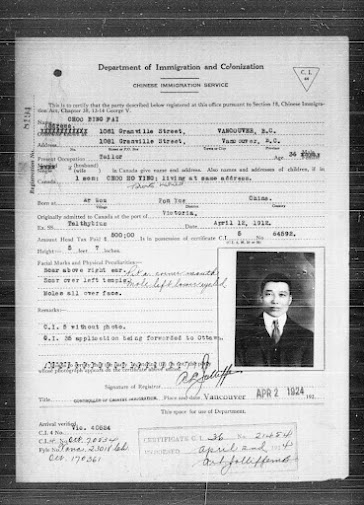
If there are family members who were in Canada in 1923, they would have been required to register when the Chinese Exclusion Act passed.  The C.I.44 was issued to certify that an individual had registered under Section 18 of the Chinese Immigration Act of 1923. Registration was required for every person of Chinese origin in Canada. The certificate recorded detailed identifying information and bore a photo and related file numbers.  Files were kept of foreign-born Chinese in Vancouver, Victoria, and Ottawa.

However, the Chinese Immigration records currently stored at the LAC are somewhat messy.  According to my colleague June Chow, who is a highly respected activist and organizer in the community, the C.I9s do not appear to be complete. There are microfilm reels that are scattered, as the records were separated by port (Vancouver or Victoria) and by foreign-born versus native-born Chinese. Some reels are digitized while some are not; some records are indexed and some are not.  "It's quite a quagmire."

With the newly released CI.44 record set, the hope is that they can lead to finding other existing record sets.  This CI.44 record set documents the mass registration required of all Chinese living in Canada when the 1923 Exclusion amendment passed.   I have submitted an ATIP request to LAC to open those records.  I'm hopeful that my search for my ancestry can continue.

Wednesday, November 30, 2022

In Search of My Genealogical Roots - The Records Remain a Mystery


From the mid-to-late nineteenth century, more than 15,000 labourers from China arrived in Canada to conduct construction work on the Canadian Pacific Railway (CPR).   Many faced discrimination, such as being paid only paid a third less than their co-workers while given the most dangerous assignments in harsh conditions.   As part of the anti-immigration sentiment in British Columbia at the time, the federal parliament passed in 1885, the Chinese Immigration Act, which stipulated that all Chinese entering Canada must first pay a $50-dollar fee, later referred to as a head tax. This was amended in 1887, 1892, and 1901, with the fee increasing to its maximum of $500 in 1903.

My great-grandfather, Choo Hang Wai, great-grandfather, Chow Bing Fai, and many ancestors, were among the more than 97,000 migrants who had to pay a headtax for the entry into Canada.  Between 1885 and 1923, the Government of Canada collects about 33 million dollars ($544 million in 2022 dollars), from about 97,000 Chinese headtax payers. The headtax system also had the effect of constraining Chinese immigration; it discouraged Chinese women and children from joining their men, so the Chinese community in Canada became a "bachelor society".

For the past 15 years, this journey to rediscover this lost part of history has been both rewarding and frustrating. My colleague at SFU Library, Sarah Zhang, and I are working on a project that ‘hacks” the historical dataset of the Chinese headtax registers (the records of migrants as they stepped off the ship and onto Canadian soil). Both a professional to personal endeavour, there have been twists and turns to how much the archives that my country is holding onto and how much it wants to release.

During the pandemic, the Library and Archives Canada (LAC) quietly rehauled their website earlier this Fall, to reflect new guidelines for Government of Canada websites. I was perturbed that this happened and worried that everything had been wiped clean. Thank you to my friend and colleague June Chow pointing me in the right direction.

Go to LAC

https://library-archives.canada.ca

- Select English or French

- At mid-page, select Most requested > Collection > "Search the collections"
- Select "Collection Search"
- Select "Advanced Search"
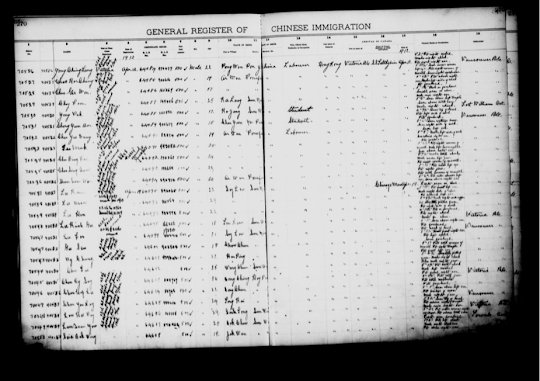
- Select from the Database: "Immigrants from China, 1885 to 1952"
- You can leave Type of record as "All" or Select from:
(a) "General Registers of Chinese Immigration" for records of arrival/entry; or
(b) the various C.I.9 certificate series, based on Vancouver/Victoria issued and/or people born in/outside of Canada


I've been disturbed by this level of difficulty for a simple search.   I had a challenging time, but I do this for a living.  How can we expect the public to use this tool for finding anything?  I really hope that this is a temporary measure by the LAC!