Wednesday, March 09, 2022

The Power of Identity Capitalism

I remember many years ago a candidate was giving a presentation as part of his interview for a senior leadership position. This candidate recounted a marvelous track record, and name-dropped some important EDI initiatives, along with some notable individuals. Of course, this was all performative as he clearly did none of what he had listed off, and in fact, had cared little about it during his tenure. It was a successful interview and he got the job. It was the first time I had encountered the positive publicity that EDI can bring to an organization, and it doesn’t even matter if you don’t support it as long as you talk about it glowingly.  I didn't know it at the time, but it was a form of identity capitalism.

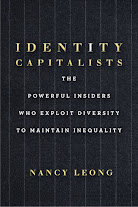
Nancy Leong’s Identity Capitalists: The Powerful Insiders Who Exploit Diversity to Maintain Inequality is a powerful book that argues through a number of case studies that identity capitalism is a process in which an ingroup benefits from outgroup identity. In North America, as are well aware, the main ingroup is usually white, male, heterosexual, and wealthy.  Identity capitalism is also a business strategy. Just professing the value of diversity helps to exonerate a company’s image at a time of negative publicity.

A lot of institutions dishonestly use racial photoshopping to inflate diversity. Have you ever noticed the meticulousness of diversity when in reality the staff is completely homogenous? Leong reveals that campuses often photoshop Black students into group photos. Identity capitalism implies that social problems are easy to solve or have been solved already, yet in reality are only a superficial and performative gesture toward a solution.  The better diversity statement is an honest one: touting the company’s accomplishments but explaining there is more work to do within and beyond the company itself.  There is always a wonderful opportunity to be humble and grow.  

Wednesday, March 02, 2022

Leadership Journey With Dr. Anthony Chow of the San Jose University iSchool


This is an inspiring video that I wanted to share after watching it.  Dr. Anthony Chow is the Director of  San Jose State University’s School of Information, appointed July 2021. Before his appointment at the iSchool, Anthony was an associate professor in the Department of Library and Information Science at the University of North Carolina at Greensboro.   His research focuses on systems thinking, technology integration, organizational management, and also information-seeking behaviour and usability in digital environments.

With an academic career that spans 21 years, he offered some really insightful experiences as a person of colour who has held leadership positions.   Anthony is an inspirational story, in a profession that is predominantly racially homogenous, and seeing how he has navigated the terrains of academia, which can be competitive and cutthroat, successfully is really a great story.    Here's some highlights that he shares with us that helped him throughout the years:  

Experience -- Age and experience helps.   After a while, Chow found that he was more comfortable as he spoke to peers on a personal level, he was around the same age and had earned his stripes.   I've found this insight to be really relatable in my own life.  If you hang in there, over time, your experience builds on itself and compounds exponentially over time.  Eventually, you will feel comfortable in your own skin, which goes a long way to how it builds confidence.  Patience is key and paying your dues.  

Get Involved -- Getting involved, whether it's emailing and making those phone calls to worthy causes.  "Prove it" to others that you care.   Eventually, they will find you and seek your leadership.

Be Kind -- Ultimately, being kind is so important.   Leadership means leading with a good heart.  Leading by an organizational chart hierarchy is called managerialism.   Leadership is something entirely different.  

Sunday, February 20, 2022

The Matthew Effect and the Digital Fault Lines of Learning

I confess that I’ve started so many MOOCs, or massive open online courses, that I’ve forgotten how many I actually completed, which is likely to be very few.   2012 was once infamously dubbed the “Year of the MOOCs” but it didn’t actually revolutionize education, not at the university/college level nor at the K-12.  I still recall with a draught of nostalgia (and wincing) when higher education administrators scrambled to push for MOOCs to be established at their institutions. My particular university called it “flexible learning” and almost overnight everyone veered towards the technology lest they would be missing out on the next educational revolution. Coined in 2008 by Dave Cormier, the first MOOC to be very successful was the course "Artificial Intelligence" by Sebastian Thrun and Peter Norvig at Stanford University in 2011, and left their positions to found Udacity. In 2012, MIT and Harvard University announced the birth of EdX. Then came Coursera. Predictions were suggested that MOOCs would spell the end of universities. Studies such as the one by Katy Jordan exposed that completion rates were dismal.

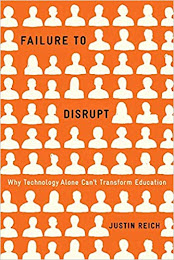
Justin Reich’s Failure to Disrupt: Why Technology Alone Can’t Transform Education reviews the post-hype MOOC world, arguing that technology cannot by itself disrupt education or provide shortcuts past the hard road of institutional change. The Matthew Effect is best summarized by the adage "the rich get richer and the poor get poorer,” and in the edtech world, it means that even new, free resources are mainly beneficial to already affluent learners with access to networked technology. Thus Reich’s three myths are really illuminating:

Myth #1 - Technology disrupts systems of inequality.

False. Technology actually reproduces the inequality embedded in systems. Poor, urban, and rural students were less likely to be exposed to higher-order uses than non-poor and suburban students. Rather than rearranging practices in schools, new technologies reinforce them.

Myth #2 - Free and open technologies promote equality.

False. Free things benefit those with the means to take advantage of them. Research shows that those who use MOOCs or sign-up for wikis tend to be from affluent neighbourhoods.

Myth #3 - Expanding access will bridge digital divides.

False. Social and cultural barriers are the chief obstacles to equitable participation. As they are often harder to discern, “digital divide” is too simple a metaphor to characterize educational inequity.   Because social and cultural barriers are harder to measure, it's often missed in the design of edtech.   
Reich suggests that students from less developed countries actually face an obstacle called “social identity threat” which can occur, for instance, when:
the elite branding of universities offering MOOCs, the predominantly white American and European faculty who offer these courses, the English language usernames in the forums, and other markers that feel excluding to minority participants. Feelings of social identity threat can lead to negative recursive cycles: when people start a class, they may feel like an outsider.
It's sobering for an individual like me who has been fortunate to work in a large educational institution in a developed economy.  Though the training I have had as an educator builds technology around connectivist and constructivist theories, I also realize much of what I do for my students is based on privileged assumptions.   Reich's book is such a thought-provoking exercise.  Would you have another title you'd recommend here?