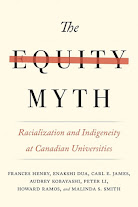
is an important title about EDI in Canadian higher education. As an academic librarian, I see firsthand the challenges of racialized, Indigenous, and female colleagues struggle in the wastewater of discrimination and prejudice, often implicitly intended, but always explicitly impactful. The monograph has a strong assortment of scholarship, each chapter covering a critical area of EDI. One of the chapters that particularly speaks to me is the “A Dirty Dozen: Unconscious Race and Gender Biases in the Academy,” where the authors Smith, Gamarro, and Toor, list twelve forces of biases that are socialized and internalized forms of racism and sexism that underpin hidden race and gender social hierarchies in academia. I've decided that the "dirty dozen" is a good place to start:
Biases before graduate school - It happens even before graduate admissions as racial and gender biases influence how important “informal pathways” are paved. As prospective faculty are gatekeepers to who is accepted or not, racialized minority and women applicants often received less favourable and frequent responses compared to White male students.
Biases in Letters of References - Race and gender stereotypes make their way into one of the most important documents of academics. Unconscious bias seeps its way into letters with negative and biased confidential references and anonymous reviews, undermining chances of success for candidates.
Biases about who gets to speak in classrooms - Unconscious biases are apparent in who speaks in the academy, in the classroom, at conferences, and at university decision-making. Significant research into race and gender biases finds evidence that the dynamic of “who speaks” is shaped by compositional diversity of both professors and students in the classroom.
Biases about who speaks at conferences - In numerous studies, it is primarily White men that are speaking while women faculty and students, listening; and in fact, men dominate 75% of conversations during conference gatherings. Conferences have marked contrast to racial/ethnic and gender homogeneity among speakers, resulting in the same social reproduction in which knowledge and its dissemination are programmed as almost exclusively male and White.
Biases in citation counts - The gender, racial, and regional biases that influence citations reinforce those biases into academic hierarchies. Studies indicate the tendency of male scholars to self-cite and cite primarily male scholars, while female scholars reproduce this citation bias citing male scholars and not their previous work, maintaining authoritative conceptions of canon, disciplines, and even the academy itself.
Biases in academic networks and social networks - As they are important for personal, professional, sponsorship, and mentorship, a lack of access to elite networks results in “old boys’ networks,” primarily White and male-dominated, fortifies the marginalization and invisibility, and exclusion racialized and women in many disciplines.
Biases in curriculum - As much of the modern disciplinary curriculum is White, Eurocentric, and colonial that continue to reflect the historical biases against women, Indigenous, and racialized scholars, scholarship from non-Western countries, diverse histories and intellectual heritages will continue to be invisible.
Affinity Bias - Unconscious biases often result in preferential hiring, with the replication by selecting new hires with similar backgrounds and demographic characteristics. “Cultural Cloning'' happens most often where there is a desire for sameness rather than diversity. As gender, race, age, and class status all matter so much, not all participants are ranked equitably; implicit bias and discrimination ultimately influence who gets hired. This propagation of homogeneity through the hiring process unfortunately prioritizes masculinity, whiteness, and European-ness.
Biases of Names and Accents - Unconscious bias towards unfamiliar names based on gender, place of origin, religion, or education from non-Western institutions, often result in discrimination. Racialized minorities sometimes need to adopt anglicized names when it could mean the difference between getting an interview or not. Accent bias has a significant impact on not only hiring, but also teaching evaluations, tenure and promotion assessments as students and professors alike have greater affinity for accents similar to their own. Studies reveal that prejudice against accented English can predetermine language proficiency.
Biases in Teaching Evaluations - Women and racialized instructors tend to receive lower teaching evaluations when compared to White men. This bias is even more apparent when studies show that White males receive higher evaluations even in online courses(!) What’s disturbing is racialized minorities receive negative feedback the most if they are teaching course content that students perceive as incongruent with their identity, such as in the humanities, while female instructors in the sciences and business, face the similarly biased negative evaluations.
Biases in Service work - Racialized, particularly racialized women, play a disproportionate role in service work, particularly mentoring racialized students. Though service is a part of promotion and tenure, it's often devalued and unrecognized. Plagued by this glass ceiling, these racialized colleagues are often stalled at the associate professor rank at their universities.
Biases in Leadership - Mid-level and senior leadership roles at universities are exclusively White and male; women and racialized scholars are mostly excluded from leadership positions. When women leaders do get hired, they are on a “glass cliff” where these leadership positions are unstable, precarious, and high-risk conditions.
It’s a sobering list. The Equity Myth is the type of scholarship that should propel change in higher education. Unfortunately, change is slow. This book first came to my attention when the Provost of my institution held up the book and conveyed that this was a must-read title. I was piqued by this, and glad that I had an opportunity to share this with you. But the academic library world is, not any less or more complex, doesn't quite fit into some of the data and stories in The Equity Myth. The intersectionality of race, gender, and sexuality (to name just a few), merits further scholarship into this area, and there are a lot of excellent ones out there, but not so much in the Canadian context. I hope to participate in a book project one day to explore this further. I'd love to hear if you have any ideas or comments.
Biases in Letters of References - Race and gender stereotypes make their way into one of the most important documents of academics. Unconscious bias seeps its way into letters with negative and biased confidential references and anonymous reviews, undermining chances of success for candidates.
Biases about who gets to speak in classrooms - Unconscious biases are apparent in who speaks in the academy, in the classroom, at conferences, and at university decision-making. Significant research into race and gender biases finds evidence that the dynamic of “who speaks” is shaped by compositional diversity of both professors and students in the classroom.
Biases about who speaks at conferences - In numerous studies, it is primarily White men that are speaking while women faculty and students, listening; and in fact, men dominate 75% of conversations during conference gatherings. Conferences have marked contrast to racial/ethnic and gender homogeneity among speakers, resulting in the same social reproduction in which knowledge and its dissemination are programmed as almost exclusively male and White.
Biases in citation counts - The gender, racial, and regional biases that influence citations reinforce those biases into academic hierarchies. Studies indicate the tendency of male scholars to self-cite and cite primarily male scholars, while female scholars reproduce this citation bias citing male scholars and not their previous work, maintaining authoritative conceptions of canon, disciplines, and even the academy itself.
Biases in academic networks and social networks - As they are important for personal, professional, sponsorship, and mentorship, a lack of access to elite networks results in “old boys’ networks,” primarily White and male-dominated, fortifies the marginalization and invisibility, and exclusion racialized and women in many disciplines.
Biases in curriculum - As much of the modern disciplinary curriculum is White, Eurocentric, and colonial that continue to reflect the historical biases against women, Indigenous, and racialized scholars, scholarship from non-Western countries, diverse histories and intellectual heritages will continue to be invisible.
Affinity Bias - Unconscious biases often result in preferential hiring, with the replication by selecting new hires with similar backgrounds and demographic characteristics. “Cultural Cloning'' happens most often where there is a desire for sameness rather than diversity. As gender, race, age, and class status all matter so much, not all participants are ranked equitably; implicit bias and discrimination ultimately influence who gets hired. This propagation of homogeneity through the hiring process unfortunately prioritizes masculinity, whiteness, and European-ness.
Biases of Names and Accents - Unconscious bias towards unfamiliar names based on gender, place of origin, religion, or education from non-Western institutions, often result in discrimination. Racialized minorities sometimes need to adopt anglicized names when it could mean the difference between getting an interview or not. Accent bias has a significant impact on not only hiring, but also teaching evaluations, tenure and promotion assessments as students and professors alike have greater affinity for accents similar to their own. Studies reveal that prejudice against accented English can predetermine language proficiency.
Biases in Teaching Evaluations - Women and racialized instructors tend to receive lower teaching evaluations when compared to White men. This bias is even more apparent when studies show that White males receive higher evaluations even in online courses(!) What’s disturbing is racialized minorities receive negative feedback the most if they are teaching course content that students perceive as incongruent with their identity, such as in the humanities, while female instructors in the sciences and business, face the similarly biased negative evaluations.
Biases in Service work - Racialized, particularly racialized women, play a disproportionate role in service work, particularly mentoring racialized students. Though service is a part of promotion and tenure, it's often devalued and unrecognized. Plagued by this glass ceiling, these racialized colleagues are often stalled at the associate professor rank at their universities.
Biases in Leadership - Mid-level and senior leadership roles at universities are exclusively White and male; women and racialized scholars are mostly excluded from leadership positions. When women leaders do get hired, they are on a “glass cliff” where these leadership positions are unstable, precarious, and high-risk conditions.
It’s a sobering list. The Equity Myth is the type of scholarship that should propel change in higher education. Unfortunately, change is slow. This book first came to my attention when the Provost of my institution held up the book and conveyed that this was a must-read title. I was piqued by this, and glad that I had an opportunity to share this with you. But the academic library world is, not any less or more complex, doesn't quite fit into some of the data and stories in The Equity Myth. The intersectionality of race, gender, and sexuality (to name just a few), merits further scholarship into this area, and there are a lot of excellent ones out there, but not so much in the Canadian context. I hope to participate in a book project one day to explore this further. I'd love to hear if you have any ideas or comments.